Thursday, October 29, 2020

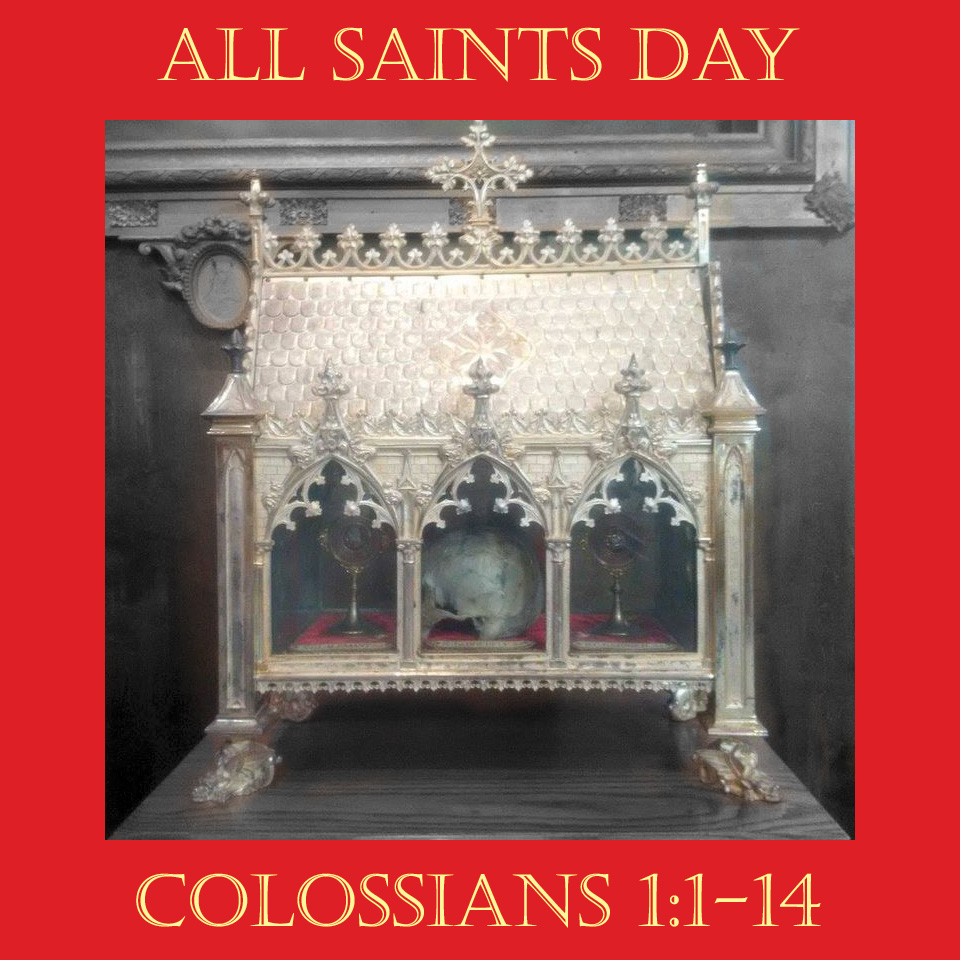
Colossians 1:1-14: You and I, All Saints Day and Holiness

Presented to Alberni Valley Ministries of The Salvation Army, 01 November 2020 by Captain Michael Ramsay and 02 November 2025 by Major Michael Ramsay


This is the 2020 version. To view the 2025 version, click here:

https://sheepspeaks.blogspot.com/2025/11/colossians-11-14-you-and-i-all-saints.html


Today is All Saints Day. What do we know about All Saints Day? It is celebrated mostly by the Mainline Churches: Roman Catholic, Anglican, Lutheran, Reformed, etc. It is the day after All Saints Eve, All Hallows’ Eve, Hallowe’en and the day before All Souls Day (which we won’t chat about today).


I will tell you a little bit what I know about ‘All Saints Day’ – though I must confess that I don't know that much as I grew up in an evangelical church rather than a mainline church - most of my information on this is simply from Doctor Google and Professor Wiki, as well as some proper commentaries, but I am not an expert by any means and I have not had a serious discussion about the Roman Catholic and Mainline understanding of saints with someone who is very well-versed in such matters since I was about the same age as my oldest two daughters are now. This is what I have ‘dug up’ about All Saints Day:


On All Saints Day in some places people visit the graves of their dearly departed and leave gifts, flowers, cards, say prayers, or sing hymns. In the USA some churches hand out candies as people come to pray for the souls of dearly departed family members, friends, and even pets. In parts of Austria and maybe Germany they have special bread that they call “All Saints Bread” which they make for their Godchildren. And then there is Portugal…


 In Portugal apparently they make something called “Soul Bread” or simply “souls”. Children then go ‘souling’ on All Saints Day. They go door-to-door and collect 'souls', this ‘soul’ bread. (This is not entirely dissimilar, and probably more healthy than trick-or-treating but I must admit that the idea of my kids going door-to-door collecting people’s souls does sound a little creepy to me!) Some people actually have the Catholic or Lutheran Priests bless the ‘souls’ before they are handed out to the children going door-to-door and apparently the children promise to pray for the souls of the deceased relatives of the people who gave them these ‘souls’ to eat. Leftover ‘souls’ are then given to the poor.


I think that in Roman Catholic understanding All Saints Day is a day to pray for all those who have ‘gone to heaven’ or at least Christians who have left this life. In Methodism, from which tradition The Salvation Army evolved, it is a time to remember the saints ‘who have gone on ahead’, both the famous ones and the obscure ones. Methodists don’t have the whole canonization process that Catholics do and John Wesley, their founder, was certainly opposed to the worship of saints but they do use the word not entirely dissimilar from the Catholic tradition. Saints in Methodism are Biblical figures and historical Christians who have gone before us: sort of like ‘Heroes of the Faith’, as I understand it.


All this -at least to me - is very interesting but do we know who saints are in the Bible? …what the word ‘saint’ actually means? Do we know what a saint really is? In the Bible ‘saint’ is another word for ‘Christian’. It is actually the preferred term for Christians in the NT.


The New Testament word for saint is ‘hagioi’ and ‘hagioi’ is actually a variant of the Greek word for holiness, ‘hagios’;[1] so then, every Christian is a saint and every Christian is by definition supposed to be holy.[2] 1 Peter 1:16, God says, “…be holy because I am holy.”


Hagios, the Greek word for holiness,[3] Hagios-Holiness-Saint-Christian literally means, from the Bible dictionaries, to be perfect or to be spiritually pure.[4] G.B. Stevens writes, “It is evident that Hagios[-Holiness-Saint-Christian] and its kindred words…express something more and higher than ‘hieros’, sacred, outwardly associated with God;…something more than ‘semnos’, worthy, honourable; something more than ‘hagnos’, pure, free from defilement. Hagios[-Holiness-Saint-Christian] is more comprehensive.”[5] 1 Peter 1:16, God says “…be holy because I am holy” and being holy, being a saint, being a Christian is more than being sacred, is more than being worthy, is more than being pure. Holiness, being a saint, being a Christian in the Bible is more than even being free from defilement. It is being perfect. Holiness is to be like God and God says “…be holy because I am holy!”


Doctrine 10 of The Salvation Army says, “We believe that it is the privilege of all believers to be wholly sanctified [holy], and that their whole spirit and soul and body may be preserved blameless unto the coming of our Lord Jesus Christ.”


Now before any of us begin to fret and say, “well I am not perfect so I am not a Christian” or just as bad “you –Michael, or whoever else- aren’t anywhere near perfect so you aren’t a Christian” remember that as 1 Thessalonians 5:23-24 reminds us, God will make us perfect, He will make us holy. When we become a part of God’s love family, we obtain a state of holiness and the closer we come to God the more holy, the more Christ-like, we become.[6] Becoming a Christian means becoming a saint, a holy person: It is all the same, as far as the Bible is concerned. The more time we spend with God the more we will be like Him. Colossians 1:12, which we read from today, says that God has already brought us into the inheritance of the saints.[7] Philippians 3:16 says that we can live up to what we have already obtained.


On this All Saints Day, I think this is important because we are all saints here. All of us who have accepted Jesus Christ as our Lord and Savior are saints; all of us who serve Jesus as our leader and the one who saves us, our rescuer. The passage we read today is from Colossians 1 and this is what Paul writes to the Christians/Saints in Colossae. And Paul gives us the same encouragement that he gave to the 1st Century Colossians. Paul encourages us, as saints, as Christians, that we have the opportunity to be filled with the knowledge of His will (Colossians 1:9) – we can achieve this by praying to God, meeting together, studying and even just reading our Bibles – This is what we can do and we can be filled with the knowledge of God’s will. And as we are filled with the knowledge of God’s will, as we know what God’s hopes and dreams are for us, we can use this knowledge to accept His invitation to life a life worthy of the Lord. As we are now – each of us – holy saints, God can actually help us to be even more holy (Colossians1:10) and His helping us out like that will please Him in every way.[8] God is certainly pleased when we are experiencing this holy life that comes from, Colossians 1:11, resisting temptation. This is important. When we are Christians, saints temptation doesn’t just vanish but our resistance to temptation strengthens us in the Lord so that we can resist even more of what come our way.


I often think of holiness in terms of addiction but we can think of it in relationship to anything that has the potential to drag us down and make us miserable. God is with us when we are addicted and/or struggling with other struggles. God is with us when we are carrying a grudge. God is with us when we are overwhelmed. God provides us a way to be free of the burden of sin and all of these things and everything else that tries to interfere with our salvation, our holiness.


My friends, my fellow saints, let me be clear on this: God is never going to give up on you. No matter what you have gone through and no matter what you are going through, God will never give up on you. No matter what you have done; no matter what you compulsively keep doing, no matter what horrible thing you may possibly do, God will not give up on you. God will not leave you. God will not forsake you; so whatever you are going through right now – no matter how hard it is – don’t give up! God has faith in you.


You can make it. This is what it means to be holy. Even if you are struggling with something absolutely terrible like addiction, God will not give up on you. Even if you are struggling with something as soul-destroying as not forgiving someone; no matter what you are struggling against, God will not give up on you. He will offer you a way out and He will offer you comfort while you are still in the midst of it trying to get through that way out.


God invites us to the peace and security of being holy even and especially in the middle of our troubles. Hebrews 13:5, Deuteronomy 31:6: He will never give up on us and so, Philippians 3:16: we can live up to the holiness that we already obtained when we first gave our lives to Christ and Colossians 1:12: so you and I, we will receive the full inheritance of the saints. On this, All Saints Day, I want to encourage you that each of you who has placed your hope in the Lord are God’s holy saints and He will never give up on you and He is more than able to deliver you from everything that concerns you today and forever more. He will deliver you and He will make you holy, even as He is holy.


[1] John D.W. Watts. 'Holy.' In Holman Bible Dictionary, general editor Trent C. Butler. Nashville, Tennesee: Holman Bible Publishers, 1991), 660. W.E. Vine. 'Holiness, Holy, Holily.' In Vine's Expository Dictionary of New Testament Word. (Nashville, Tennessee: Royal Publishers Inc., 1939), 555.

[2] Ralph P. Martin, Ephesians, Colossians, and Philemon (Interpretation: Louisville, Kentucky, USA.: John Knox Press, 1991), 101 Holy ones recalls Israel's destiny as God's elect.

[3] Cf. The New Strong’s Exhaustive Concordance of the Bible, ‘40: Hagios’ (Nashville, Tenn.: Thomas Nelson Publishing, 1995), 1.

[4] John D.W. Watts. 'Holy.' In Holman Bible Dictionary, general editor Trent C. Butler. Nashville, Tennesee: Holman Bible Publishers, 1991), 660. Cf. Paul Minear, Interpretation 37 no 1 Ja 1983, p. 22: In his death and resurrection, Jesus' holiness or sanctification became the measure and standard of all holiness, whether of places, times, things, or persons. (Key passages which reflect this are John 10:36; 17:17-19; I Cor. 1:2; 6:11; Heb. 2:11; 10:10; 12:14-24; 13:12-14.)"

[5] G.B. Stevens in Hastings’ Bible Dictionary. Cited W.E. Vine. 'Holiness, Holy, Holily.' In Vine's Expository Dictionary of New Testament Word. (Nashville, Tennessee: Royal Publishers Inc., 1939), 557.

[6] Curtis Vaughan, The Expositor's Bible Commentary, Pradis CD-ROM:Colossians/Exposition of Colossians/I. Introduction (1:1-14)/A. Salutation (1:1, 2), Book Version: 4.0.2 : This suggests that the root idea in "holy" (hagios) is not excellence of character but dedication, the state of being set apart for the work and worship of God. 

[7] Cf. Solomon Andria, Africa Bible Commentary, (Nairobi, Kenya: Word Alive Publishers, 2010), 1482.

[8] NT Wright, Paul for Everyone: The Prison Letters (Louisville, Kentucky, USA.: John Knox Press, 2004). 142-147, likens it to new plants growing in a garden replacing the old but acknowledges that we have apart to play in it like ducks following their mother.


Saturday, October 17, 2020

Colossians 3:1-15: No Future without Forgiveness

Presented to Alberni Valley Ministries of The Salvation Army, 18 October 2020, by Captain Michael Ramsay


This week I watched most of the BC Leaders debate with Susan – I wasn’t going to. I don’t really care so much about what the leaders say on TV; I care more about their performance in the legislative assembly. The cynical side of me thinks that they are just guessing what the most popular positions are and then trying to say how good they are at those things while they belittle their opponents. I must say though that I thought this was the least ‘naggy’ and ‘interupty’ leadership debate I have seen in a while. My wife will disagree with me on that. She didn’t care for this debate at all. Myself, I honestly don’t care as much about who the next premier will be as I do about who our next MLA will be as we will inevitably have to work with them around important issues in our community: housing and homelessness, addiction and mental health, etc., so I definitely plan to listen to the debate between Josie, Helen, Graham, and others here.


As far as leaders debates are concerned I am always more interested in seeing who wins the media war after the debate than who wins the live engagement. I think that matters more because more people follow the news than bother to tune into a debate. I noticed that our premier felt that he needed to apologize, retract, and/or re-think some of the comments that he made. To me that is good – very good. In my job I deal with people’s apologies all the time. I pray with people who apologize to God and their neighbours. I, myself, apologize when I should. Apologizing is a first step in repentance. You have to acknowledge you did something wrong in order to change and acknowledging that to someone else can be a blessing for both of you as you each get a chance to see into the other person’s heart a little bit.


AA, with which I have had a lot of dealing over the years and who rent our space during the week have as their 5th step to recovery “Admit to God, to ourselves, and to another human being the exact nature of our wrongs”. Apologizing is an important step in our own growth in relationship with God and others.


I was shocked when I read a Facebook post from a Facebook friend who is a community leader in our town. This person, who I thought actually supported the premier’s party said that he can’t forgive him. The comments went on quite a while with many people weighing in and this person – who I thought was on the same political page as our premier – was determined to use the Premier’s particular turn of phrase to paint our Premier (rightly or wrongly) as a racist. It was a point of no turning back. It was a Rubicon. I was shocked and saddened.


There is a lot of racism - straight up, reverse, systematic and otherwise in our world today. There was a lot of racism, systematic and otherwise in NT times too. Our text today repeats a common NT theme when Paul communicates, “Here [in the Christian community] there is no Gentile or Jew, circumcised or uncircumcised, barbarian, Scythian, slave or free, but Christ is all, and is in all.” African scholar Solomon Andria writes in the Africa Bible Commentary, “The person in whom this image [of God] is restored is capable of overcoming the racial, religious, and social barriers that separate Greek from Jew, circumcised from uncircumcised, foreigner from locals,  and slave from free…in Christ they are all equally members of the Christian community.” Solomon Andria further says, “This text is highly relevant in Africa, where ethnic tensions still persist, even among Christians.”[1] I would say that applies to North America as well.


We can understand that when most people say ‘Black lives matter’ that they mean ‘Black lives matter too”; we can understand that when most people say ‘all lives matter’ they mean ‘all lives matter – even and especially black lives and indigenous lives and barbarian lives, and Scythian lives, and slave lives…’.  If a person says they are colour blind they may be ill-informed but they are probably not trying to offend you. They are probably not saying you are invisible. They are probably using what was once thought of as inclusive language (even if now it is not!) They are probably trying to communicate to you that they care about everyone. As far as the Kingdom of God is concerned, after all, “…there is no Gentile or Jew, circumcised or uncircumcised, barbarian, Scythian, slave or free…” We don’t need to pick fights over words. We should try to be gentle and inoffensive in the words we use – don’t use the words and phrases we know are going to wind some people up! (And if you inadvertently do, apologize) Also try not to be so offended. A nation where everyone is fragile soon breaks apart – a nation where people constantly throw hate and insults at each other soon shatters. Where there is no forgiveness there is no reconciliation. Where there is no forgiveness there is no future.


Also this week I read an interview with Arsene Wagner, he managed Arsenal FC for 22 years. One comment he made about the difference between managing a high profile professional football club when he first did and now was that 20 years ago people paid more attention to the 60 000 people who would be actually watching a match; now they pay more attention to 50 or so people who complain about the match on-line – whether they bothered to buy a ticket to the game or not! That struck me. Is this what we have become? …A bunch of people who would rather complain about something than participate in it?


Those who know me know there are a few authors whose ideas resonate with me quite a bit. Tolstoy (a Russian author and former soldier), MLK (an American pastor), ImmaculĂ©e Ilibagiza (a Tutsi from Rwanda) are three of them. A key part of God’s message which He shares with us through them is the need for forgiveness. Yes, the need for us to be forgiven but even more so the need for us to forgive others: there is no future without forgiveness.


Not long ago, I picked up this book from the retired South African Archbishop, Desmond Tutu. Do we know who Desmond Tutu was? He was a key figure God used to liberate South Africans from apartheid. This book is entitled “No Future without Forgiveness”. This I think is one of the key lessons that one can learn from life. This I think is a major part of the secret to living in God’s proleptic Kingdom both for now and forever. There is no future without forgiveness.


Desmond Tutu tells this story about his decision to serve Jesus as an Anglican Priest. When he was 12 years old, his family moved to Johannesburg. Tutu and his mom had an encounter with an Anglican priest from England, Trevor Huddleston. Tutu said, “I was standing in the street with my mother when a white man in a priest's clothing walked past. As he passed us [stepping off the path rather than expecting us to do so] he took off his hat to my mother. I couldn't believe my eyes.” It was at that moment young Desmond Tutu decided to be an Anglican Priest. Just think. The power of God in that Trevor Huddleston helped transform a whole nation simply by tipping his hat and greeting someone as his sister in Christ (Trevor Huddleston also did a lot of other work for the Kingdom and to end apartheid!); in the Christian community, Colossians 3:11, “there is no Gentile or Jew, circumcised or uncircumcised, barbarian, Scythian, slave or free, but Christ is all, and is in all.”


2 Corinthians 5:17-19: “… if anyone is in Christ, the new creation has come: The old has gone, the new is here! 18 All this is from God, who reconciled us to himself through Christ and gave us the ministry of reconciliation: 19 that God was reconciling the world to himself in Christ, not counting people’s sins against them. And he has committed to us the message of reconciliation.”


I think this is very important. As movements such as BLM emphasize, we do need to recognize the special needs, talents, and gifts of different people in our society (I think this is what is meant by not being colour blind). Paul in his first letter to the Corinthians through his beautiful analogy to the human body, points out that we all have special gifts and abilities and some of us do need to be treated more delicately than others (1 Corinthians 12:12ff). And Paul here and in other letters points out that we need to avoid dwelling on our differences, instead we need to realize that we are all God’s people building His Kingdom here together. Solomon Andria writes in the Africa Bible Commentary, “Christian virtues will restore human relationships. But they can only be shown if we are willing to forgive each other.”[2] There is no future without forgiveness.


There were a lot of legitimate grievances between different groups in NT times, just like in OT times, just like today. There were obviously power differences between slaves and masters, challenges between males and females, disagreements between the circumcised and the uncircumcised, and very real culture clashes and overt prejudices between the Jews and the Gentiles and others. There is only one way these systemic abuses, historic and other grievances can be settled. There is only one way Jews and Greeks, male and female, slave and free, black and white, x and y can be reconciled and that is through forgiveness. We can only be reconciled in Christ to God and our neighbour if we no longer hold each other’s sins against each other. There can be no reconciliation without forgiveness. There can be no future without forgiveness.


This works – not only in relationship to Heaven, the Kingdom to Come, but also in our day-to-day lives. In the South African version of a Truth and Reconciliation Commission people traded truth for reconciliation. People admitted their guilt even in some horrendous crimes: murder, rape, assault, etc. And instead of being castigated, caged and killed they were forgiven and as a result South Africa has survived and thrived in ways that other nations can only dream of. Bishop Tutu points out that none of this would be possible if South Africa had pursued a Nuremberg vision of justice. It was only possible because they were willing to forgive one another. There can be no reconciliation without forgiveness. There can be no future without forgiveness.


Today Canada is as divided as at any time in my life. I have never heard so much hate. Today the churches are more divided than I think the Apostles could ever have foreseen. As long as we keep pointing out flaws of others, as long as we keep taking the sliver out of another’s eye instead of the plank out of our own (Matthew 7:5), as long as we keep talking about people instead of to them, as long as we let ourselves get worked up by others' errors and omissions more than our own, we will never experience freedom in Christ.


Here is a key point - one I have made before and one I will make again: Un-forgiveness is a self-inflicted wound. If I don’t forgive you I am not hurting you, I am only hurting myself. You might not even know that I am upset – but I do!


Un-forgiveness can get into our soul and drive a wedge between ourselves and our neighbour and even between ourselves and God. Matthew even says that if we do not forgive our neighbour their sins God will not forgive us ours (Matthew 6:15).


In South Africa they have a word ‘Ubuntu’ which both Bishop Tutu and President Mandela refer to frequently in their books.[3] It means something like ‘a person is a person through other people’. As John Donne would say, ‘no man is an island unto himself’.[4]  We are all connected and whatever I do to you I feel in myself: Ubuntu. My friends, that is what forgiveness is about. Un-forgiveness is hurting yourself when you are mad at your neighbour. Un-forgiveness is removing yourself from the Kingdom of Love and Forgiveness. Un-forgiveness drives a wedge between you, me and Christ.


But Christ died on the Cross and rose from the grave so that you and I can forgive and be forgiven. And forgiveness is receiving God’s healing by loving your neighbour; forgiveness is being restored to His Kingdom of Love and Forgiveness; and forgiveness is the force by which you and I can be reconciled to God and to one another.


By forgiving others and accepting Christ’s forgiveness we will become a new creation, Tutu says we will live in a new dispensation. The old pain and suffering of hate and retribution will be gone. Christ can cleanse our soul, remove our sins and grant us the full power to forgive others - even has he has forgiven us. Make it so!


Let us pray.


Further reading:

N.T. Wright, NT Wright, Paul for Everyone: The Prison Letters (Louisville, Kentucky, USA.: John Knox Press, 2004). 395.

Ralph P. Martin, Ephesians, Colossians, and Philemon (Interpretation: Louisville, Kentucky, USA.: John Knox Press, 1991).


Notes:

[1] Solomon Andria, Africa Bible Commentary, (Nairobi, Kenya: Word Alive Publishers, 2010), 1482.

[2] Solomon Andria, Africa Bible Commentary, (Nairobi, Kenya: Word Alive Publishers, 2010), Colossians 3:12-14: Clothe yourself in virtue, 1482.  

[3] Desmond Tutu. No Future Without Forgiveness (New York, NY, USA, Double Day, 1999)31and Nelson Mandela, Long Walk to Freedom (New York, NY, USA, Little Brown & Co,, 1994)

[4] John Donne, Meditation 17: Devotions upon Emergent Occasions (London, UK,1614)

Saturday, October 3, 2020

Reading Genesis 38 on MMIW Day

Presented to The Salvation Army Alberni Valley Ministries, 04 October 2020 by Captain Michael Ramsay. (Similar to talk presented to Swift Current Corps of The Salvation Army, 13 Oct. 2013 and 614 & Warehouse in Toronto, 16 Oct. 2016)


Last Sunday in the Army world we highlighted human trafficking and modern day slavery. Last Wednesday Canadians wore orange shirts to remember the predominately First Nations victims of abuse in residential schools and remind ourselves that every child matters. And today is a day to remember the MMIW which is why I am wearing a red shirt with my uniform.


Tamar, in our text today, isn’t an Israelite. Tamar is an indigenous person to the land later occupied by Israel. Tamar is a Canaanite.[1] We remember from the story of Noah that the Canaanites were cursed for generations for the sins of their father, Ham (Gen 9:25-29). Judah, Israel’s chosen son, marries his son to Tamar - this Canaanite woman – which is later prohibited and then his son dies before he has any children.[2]


Do we understand what is going on in this story with Judah’s sons, the brothers? In Israel in those days, territorial inheritance was very important and so was having a son to inherit that property. Because of this they had a rule that if a son died without an heir then his younger brother was supposed to have relations with his widow and the child that results from that would be the heir for his brother. That way the older brother would have an heir and his descendants would not lose their claim to a part of Israel.


Judah cooperates with this rule and Judah gives his second son to Tamar, the widow of his first son. Judah’s second son however stands to inherit all of his brother’s inheritance if he doesn’t produce an heir; so instead of impregnating his brother’s widow Tamar, he uses ‘protection’ of sorts. He doesn’t complete the job. This makes God mad because Judah’s son Onan was not only hurting Er, his deceased brother, but he was also hurting Tamar, his brother’s indigenous widow, and he was hurting Judah, his father, and he was hurting his whole family’s inheritance.[3] God takes Onan’s life. So now Judah has lost his two oldest sons and his eldest son’s widow Tamar is still without an heir for the eldest son and now the second son is also without an heir.


In that place and at that time there was probably not a more vulnerable person in society than a childless widow – especially since she was an indigenous Canaanite rather than an Israelite. A widow without a child has no one to care for her and Judah, while Tamar is in this state, Judah sends his daughter-in-law away. He says that his youngest son is far too young for her and he sends Tamar away without providing the heir that he must provide. Judah puts himself before the command to provide an heir for his son and Judah puts himself before the command to look after the widow in his own household.


Judah sends her away. He doesn’t seem to concern himself with her again. His youngest child grows up and Judah never fulfils the obligation to give him to Tamar or to invite Tamar back into his clan where she belongs.


Tamar is being the good widow at this point, even though she has been sent away; she has been faithfully living in seclusion while wearing her widow’s clothing for all these years. She then hears that her father-in-law is coming to town so she puts on some nice clothes and goes to meet him. Judah sees her and he mistakes her for a prostitute. Here is an opportunity that appears. Judah owes her a son and Judah thinks she’s a prostitute. Judah decides that he wants to use her services but he doesn’t have any money; so Tamar – thinking on her feet - asks for his signet and cord. A signet is like a signature - it is unique to the individual - so one can see how Tamar is taking advantage of this God-given opportunity.[4] Tamar does become pregnant. Some people find out about this and tell Judah that his daughter-in-law (who is supposed to be celibate) is pregnant. The law says that she should be put to death, especially as this happened, so rumour has it, as a result of prostitution. It is at this point that she lets Judah know that he is the father. Judah then admits his sin, what he has done to her and to his family. She gives birth to twins. Judah takes responsibility for his children, one of whom is the direct ancestor of our Lord and Saviour, Jesus Christ. Judah even admits that Tamar is more righteous than is he. Tamar is not a prostitute; she merely conceives the children who were promised to her.[5]


So why is this story in the Bible? It is important. The fact that a child of this encounter is an ancestor of both King David and Jesus Christ is mentioned more than once, by more than one author, writing at more than one distinct era in history (cf. Ruth 4:18-23, Mt 1:3). Matthew in the New Testament makes a point of mentioning that it is Judah’s son by Tamar who is in Jesus’ line and Matthew and Ruth even tell us which one of the twins he is: Perez. This story is very important in the history of Israel. This story is very important in the ancestry of King David and this story is very important in the ancestry Christ Jesus, so why is it important to us? And what does it mean to us today?


I think the key point here lies in who is Tamar: Tamar is an indigenous Canaanite woman. The Canaanites were the cursed descendants of Ham. Tamar was cursed; she is a woman; she is a widow; she is an abused indigenous widow who has been even further marginalized and further taken advantage of by privileged Israelites and she, Tamar, is an ancestor of Christ. You couldn’t be much more on the margins of society than is Tamar and God chose Tamar to be the ancestor of Jesus.[6] God chose Tamar to be in the family line of His only begotten Son. Tamar is loved and she is chosen of God.


Jesus in his ministry is always helping the poor, the widow, and the immigrant. Tamar is just that and Tamar is Jesus’ ancestor. God used Tamar – and Judah - to save the whole world - her life and actions led to Christ.[7]


Last week we remembered the victims of human trafficking, many of whom in the Canadian context are indigenous, in church. This past Wednesday many of us wore orange to remember the victims of abuse in the residential school system. Today is red dress day where we are encouraged to remember the Missing and Murdered Indigenous Women of Canada.


God has always had a heart for those who are marginalized. God has always lifted up those who have been kept down. And as God could and did use Tamar, who was abused and marginalized to extremes that some of us can only imagine - so too can God use us. No matter who we are in this life, if we are marginalized and sometimes think that others think of us as nothing or maybe we even at times have thought ourselves to be nothing. Let us remember that like Tamar, God loves us. He can save us and God can use even us to point others to His Salvation both now and forever.


Maybe we identify more with Judah. Maybe we have been also like the abusers of Tamar. Maybe we have made serious mistakes and/or committed abusive egregious sins, even as horrendous as Judah; no matter what we have done, God loves us. He can change us. He can save us and God can use even you and even me to point others to His Salvation both now and forever.


Let us pray.


www.sheepspeak.com

https://www.facebook.com/Salvogesis/

---

To view the Saskatchewan 2013 presentation click here: http://sheepspeaks.blogspot.com/2013/10/thanksgiving-at-judahs-house.html

To view the Toronto 2016 presentation click here: http://sheepspeaks.blogspot.ca/2016/10/genesis-38-judahs-family.html
 

[1] But cf. John H. Sailhamer, The Expositor's Bible Commentary, Pradis CD-ROM:Genesis/Exposition of Genesis/VI. The Account of Jacob (37:1-49:33)/D. Judah and Tamar (38:1-30), Book Version: 4.0.2

[2] Cf. Thomas W, Mann, The Book of the Torah: The Narrative Integrity of the Pentateuch, (Louisville, Kentucky: John Knox Press, 1988), 66-68.

[3] Derek Kidner, Genesis: An Introduction and Commentary. Downers Grove, IL : InterVarsity Press, 1967 (Tyndale Old Testament Commentaries 1), S. 199: The fact that a single Hebrew word suffices for the phrase perform the duty of a brother-in-law (rsv) would confirm that this was a standard practice, even if there were no record of the law in Deuteronomy 25:5ff. Each of the three Old Testament references to this regulation (cf. Ruth 4:5f.) shows that it could be most unwelcome, chiefly through the very fact that the donor himself set great store on family inheritance—but his own. The enormity of Onan’s sin is in its studied outrage against the family, against his brother’s widow and against his own body. The standard English versions fail to make clear that this was his persistent practice. When (9) should be translated ‘whenever’

[4] Cf. Terence E. Fretheim, The Book of Genesis, (NIB I: Abingdon Press: Nashville, 1994), 606.

[5] Cf. Walter Brueggemann, Interpretation: Genesis, (John Knox Press: Atlanta, Georgia, 1982), 311.

[6] Cf. Dorothy Jean Weaver, “‘Wherever This Good News Is Proclaimed”: Women and God in the Gospel of Matthew’, in Interpretation 64, no. 4, (October, 2010) 394-395

[7] cC. Walter Brueggemann, Interpretation: Genesis, (John Knox Press: Atlanta, Georgia, 1982), 311.

Friday, September 18, 2020

Psalm 23:4: Covid-19 and the Shadow of the Valley...

Presented to Alberni Valley Ministries of The Salvation Army, 20 September, 2020 by Captain Michael Ramsay


A Psalm of David.

1 The Lord is my shepherd; I shall not want.

2 He maketh me to lie down in green pastures:

he leadeth me beside the still waters.

3 He restoreth my soul:

he leadeth me in the paths of righteousness for his name’s sake.

4 Yea, though I walk through the valley of the shadow of death,

I will fear no evil: for thou art with me;

thy rod and thy staff they comfort me.

5 Thou preparest a table before me in the presence of mine enemies:

thou anointest my head with oil; my cup runneth over.

6 Surely goodness and mercy shall follow me all the days of my life:

and I will dwell in the house of the Lord for ever.


I was going to continue to look a little further into Psalm 119 but with school coming back and the covid-19 coronavirus cases on the rise and the number of personal crises that have been shared with me over the previous week or so, I have had the 23rd Psalm running through my mind. Especially the line, 'Yea, though I walk through the Shadow of the Valley of Death"


Now the Valley we live in is more like Eden than Death in its natural beauty. I don't know that there is anywhere in this world that is more beautiful than our Island for sure. The number of waterfalls, rivers, mountains, lakes, forest trails, animals: bears, eagles, deer. I am certain I have seen more bears since I have been living in the Valley than I have in the rest of my life combined - certainly more than when we worked in inner city Toronto and inner city Vancouver. And the deer: sometimes I think there may be more deer than people in my neighbourhood and sometimes I think I can recognize the deer that live in my neighbourhood more than the people who are my neighbours! This is a very beautiful part of the world.


Lately with all the deaths in our community, it has felt like there is a shadow of death, however, hovering over our valley. I think I’ve heard of 4 deaths in the past week or so alone - at least one of these, people with our CRU outreach responded to. And added to all this, of course, is the real significant stress and fear around Covid-19 and its possibility of spreading in our community. The numbers in the province and on the Island are in the rise. "Yea, though I walk through the Shadow of the Valley of Death"


I have read or recited this Psalm what feels like a million times: for Legion events, at funerals, in Church, I have had a plaque from my Great Grandmother with this scripture and a picture of Jesus with some lambs on my wall since I was a child and still to this day. I wrote an article on parts of it at the request of a former AC.[1] I feel like I have read or recited this psalm a million times before - like I said - but this week has been the first time I have read this phrase with a twinge of terror at the idea of a shadow of death overhanging us.


There is a range of ideas for the setting of this psalm. Some see it as a speech before a sacrificial meal. Others see it as a two part psalm used in worship.[2] It is significant, however, that the language contained in this psalm is very personal. As such, Lundbom argues that it is likely David, King of Judah and Israel, composed this psalm when he was on the run for his life, from his son.[3]


This would then be the context (See 2 Samuel 13-18): David had been King for a long time. His popularity with the people had waned significantly. If there were opinion polls back then he probably would be polling in the single digits. And by this time in his life he really had abrogated a lot of his responsibilities: rather than naming and training a possible successor he had left a power vacuum into which his son and his nephew had moved.


Two of the primary duties of the King in ancient Israel were overseeing the courts and leading the Army; a third would have been for his family and keeping tabs on palace intrigue. David lost control of his Army a long time ago. His nephew Joab, who had saved David on more than one occasion - not only militarily but also from the wrath of God (2 Samuel 24:2) - moved solidly, along with his brother Abishai, into a position of controlling the armed forces (2 Samuel 3:39). David, more recently to the writing of this psalm had also lost control of his courts (2 Samuel 15). And David it seems never had control over his Palace and his family.


By this stage in his life children of his had already raped or murdered other children of his. David's son Absalom it seemed never forgave his dad for failing to act when Absalom's half-brother, Amnon, raped and further victimized Absalom’s sister Tamar.[4] In Absalom's eyes, his dad let his brother 'get away with’ raping his sister! Absalom loved his sister and took care of her in part because his dad, her dad refused to protect her, care for her, or even address the issue with their half-brother Amnon, who raped her. Due to David's action or lack thereof, Absalom did later have the rapist murdered (2 Samuel 13:23ff). From this point on there seemed to be no turning back. It seems like David - though he did apparently love his sons anyway - was forever ineffective and Absalom did not feel loved - he was trapped and hardened by un-forgiveness.


By the time this psalm would have been composed by King David, his son Absalom had long taken over the court system (at least four years previous). He was also engaging in a lot of the political engagements that his father was forsaking. Absalom, like an opposition leader in parliament today, was taking every opportunity to tell everyone how much better life would be if he were in charge in place of his father. Absalom then rallied the people and many of the leaders of the people and also many members of David’s family and they sent David packing. They declared Absalom ruler in place of David (2 Samuel 15).


Joab, the army he controls, a few trusted family members and members of David's administration, and David flee Jerusalem. There is now another civil war: this one pitting Absolam's forces against Joab's forces and King David.


This is a very personal psalm.[5] David is running for his life as his country, and his very son (for whom he professes great love) has rejected him. He may die. He has lost and may forever lose his throne. He has lost his family. Many people are about to die. His son may die. And all of this, at least in part, is his fault. This is the shadow of death that is cast over David's Valley.


David, as we have said, does seem to be a long way away from the time and circumstances when he was initially declared 'a man after God's own heart' (1 Samuel 13:14). David knows all that has transpired. David is feeling the weight of life's circumstances and his own behaviours - as well as those around him. He has work problems and family problems. This is his shadow of death. And in the midst of his shadow of death, after he may or may not have even drifted from God in his life he writes:


1 The Lord is my shepherd; I shall not want.

2 He maketh me to lie down in green pastures:

he leadeth me beside the still waters.

3 He restoreth my soul:

he leadeth me in the paths of righteousness for his name’s sake.


As Brueggemann writes, "it is not the place but the vitality of the relationship which transforms"[6] David realizes - as we all have opportunity to, especially when everything seems to go sideways that God is the shepherd, not us (Jesus is the Good Shepherd, John 10:11-12). God is in charge.


  • God loves us so much that he will lead us to green pastures and still waters (even when everything is going sideways He will provide for us)
  • When we are in the depth of despair God can restore our soul
  • AND as bad or as far from God as any of us may be or may have been God can and will (as we invite Him) restore us to righteousness. No matter how wicked we have been, God can bring us to righteousness


4 Yea, though I walk through the valley of the shadow of death,

I will fear no evil: for thou art with me;

thy rod and thy staff they comfort me.


The rod and the staff remind us of the contemporary sheepdog. The dog is a natural predator of the sheep. It is only the good shepherd that causes these predators to become protectors. God is with us and can protect us and keep us even in the midst of all life’s predatory problems.[7]


Thus ends the shepherd analogy and begins a banquette analogy:[8]


5 Thou preparest a table before me

in the presence of mine enemies:

thou anointest my head with oil; my cup runneth over.


Even as David's enemies - his friends and family - are literally waiting to pounce upon, kill and/or capture him, the Lord is providing him with food and support and love and it overflows onto him. David who has possibly been far from righteousness is now being restored and cared for in these his most difficult and trying times. And as a result,


6 Surely goodness and mercy shall follow me

all the days of my life:

and I will dwell in the house of the Lord for ever.


So it is with us today. There are some horrible fears right now. Covid-19 has cast itself like a shadow over our valley. These weeks people are afraid of the children going back to school. People are unsure even as we are now allowed to be in more places. We are afraid for our family members. We are grieving the things we are losing: seeing our loved ones, social gatherings, sports events, concerts, weddings, funerals, graduation ceremonies, college campus life, sports and other scholarships evaporating, uncertain job and economic outlooks; abuse and addiction on the rise. The shadow of death is rearing its head above our valley and has caused literal death of members of this valley in the past weeks. There is uncertainty and there is fear as the shadow of death looms over our valley.


But here is the hope and the hope is real. Jesus was born, died and rose from the grave. Jesus is the Good Shepherd (John 10:11-12). He does not leave us in times of trouble and the Lord does even now prepare a table before me and you and before each of us in the very real presence of our fears and our enemies. The Lord provides for us in the midst of Covid-19; the Lord provides for us in the midst of the opiod crisis; the Lord provides for us in the midst of the economic crisis, and the Lord provides for us in the midst of all of our personal crises. No matter what you are going through, the Lord is here with you.[9] No matter what you have done, felt, thought or experienced the Lord is here with you and you can experience His righteousness. No matter what will happen after dinner, today the Lord is preparing for you a feast - a feast of love and forgiveness for you and for me; so that you and so that I can experience the freedom of our forgiveness for others, His forgiveness of us and His peace forever more.


As trying as things may be, I need not fear for the Lord is my shepherd and He will take care of me. As trying as things may be, you need not fear for the Lord is your shepherd and He will take care of you.


Let us pray


[1] Michael Ramsay, 'We are Sheep' Renew Network (Monday, August 24, 2009), online: http://renewnetwork.blogspot.com/2009_08_01_archive.html#4247040791585143519

[2] Peter C. Craigie, 'Psalms 1-50', 2nd  ed. (WBC 19: Word Books: Dallas, Texas, 2004), 205

[3] Jack R. Lundbom "Psalm 23: Song of Passage," Int 40 [1986]: 6-16

[4] cf. Michael Ramsay, " 2 Samuel 13-18: Taking Matters in His Own Hands: the Story of Prince Absalom" Presented to Nipawin and Tisdale Corps November 18, 2007 and Warehouse 614  Toronto 230 pm service, Aug 20, 2017. Available on-line: https://sheepspeaks.blogspot.com/2007/11/2-samuel-13-18-taking-matters-in-his.html "

[5] John Stott, Favourite Psalms, (RG Mitchell Family Books: Willowdale Ontario: 1988), 32; cf Willem A. VanGemeren, The Expositor's Bible Commentary, Pradis CD-ROM:Psalms/Exposition of Psalms/BOOK I: Psalms 1-41/Psalm 23: The Goodness of God/I. The Lord Is My Shepherd (23:1-4), Book Version: 4.0.2

[6] Walter Brueggemann, Praying the Psalms. (Winona: St. Mary's:1982), 156

[7] Michael Ramsay, 'We are Sheep' Renew Network (Monday, August 24, 2009), online: http://renewnetwork.blogspot.com/2009_08_01_archive.html#4247040791585143519

[8] But cf. Peter C. Craigie, 'Psalms 1-50', 2nd  ed. (WBC 19: Word Books: Dallas, Texas, 2004), 205

[9] Cf. Revd Canon Marilyn Parry, M (2009). 3rd May 2009: 4th Sunday of Easter. The Expository Times, 120(7), 337–338. https://doi.org/10.1177/0014524609103469