Wednesday, March 6, 2013

Luke 15:11-32: Lost Boy

Presented to Swift Current Community Lenten Lunch, 07 March 2013
Presented to Swift Current Salvation Army and CKSW Radio 10 Mar 13
and TSA Alberni Valley Ministries, 05 October 2025 
by Captain (Major) Michael Ramsay

This is the 2013 version; to view the 2025 version, click here:


A distinguished, prominent big city pastor cruised through a small town. He became a little turned around and when he was lost and driving through the streets of this prairie town his eyes fell upon a child not more than two feet tall at the door of one of the houses. The boy was on tiptoes valiantly attempting to reach the doorbell. Amused at the efforts of this small boy and wanting to help, the pastor parked his car and went over to assist the boy. He reached up and pushed his finger onto the button and the chimes rang inside. Satisfied that he had done his good deed for the day, the pastor turned to the child,
“Okay, what happens next?”
With a smile the child replied, “Now we run!”
.
The pastor of our story today was at a loss, I believe, as he was lost in the prairies. Today we are speaking about the lost. We read the parable of the lost son. This is actually the 3rd parable in a series of 3 or 4 parables. The parable of the lost son and especially the parable of the lost coin and the parable of the lost sheep are all speaking about how important the lost are to God and just how much He will do to bring them to salvation, to bring them back to Him.[1] The next parable after the parables of the lost then goes on to explain just how important this salvation from the Father is. God really loves us. So, to make a gross understatement, it bothers Him when we are lost.
.
Who here likes to lose things? How do you feel when you lose your keys? You know that feeling? You think you put them somewhere but they are not there. You are running late. You need to be somewhere and your keys are missing. This is like the parable of the lost sheep.
.
Now imagine that you find your keys and you head to the mall and you go in, buy your groceries, you walk to where your car is (or at least where you thought it is) and it is not there. Your car is lost. You look around. You fumble for your fob to try and make the horn honk or the lights blink but it is icy and you have your hands full and you are sure that this is where you left your car but it is lost and you are franticly scanning the parking lot wondering where it might be. This is a parable of the lost coin.
 
Now imagine that you are still standing there completely disoriented with your hands full in the middle of the parking lot franticly looking for you car and you spot it so you walk over to the car. You are wondering why you can’t get it to unlock and then you realize that it is not your car at all. It is just one that looks like your car. You look around. You can’t find your anywhere and you are really starting to get concerned now because, even though you know you shouldn’t have, you left your two year-old grandchild or daughter or son in the car. This is the parable of the lost son. These are the progressive emotions that Luke is trying to evoke in his original audience here as they read of and hear these parables from Jesus.
 
These three parables are of the lost: the lost coin (vv. 3-7), the lost sheep (vv. 8-10) and the lost son (vv.11-32). They are a progression of intensity and they all address the questions raised by the Pharisees in verses 1-2 that we read earlier: “Now the tax collectors and sinners were all gathering around to hear Jesus. But the Pharisees and the teachers of the law muttered, ‘This man welcomes sinners and eats with them.’”
 
Jesus answers the muttering in these parables that not only does he welcome sinners and eat with them but Jesus says: Verse 10, “In the same way, I tell you, there is rejoicing in the presence of the angels of God over one sinner who repents”; Verse 7, “I tell you that in the same way there will be more rejoicing in heaven over one sinner who repents than over ninety-nine righteous persons who do not need to repent”; and Verse 32 “…we had to celebrate and be glad, because this brother of yours was dead and is alive again; he was lost and is found.’” This is how much it means to God when we His children come to and/or return to His safety and His protection.
 
Now the primary parable of the lost that we are dealing with today is that of the son. I must admit that it wasn’t my favourite pericope to see that I would be speaking on because it seems that almost everything that could ever possibly be said about this parable has been said already. I have read I don’t know how many journal articles and books on the prodigal son; I have seen I don’t know how many pieces of artwork on the prodigal son; I have heard I don’t know how many homilies, devotional thoughts and inspirational talks on the prodigal son. I have heard sermons spoken from the father’s perspective, from the prodigal’s perspective, from the older son’s perspective and maybe even from the pigs’ perspective. I myself have even written a children’s version of this story many years ago and years before that even I remember playing the prodigal son in a musical when I was an elementary school student back in Victoria, with Emmanuel Baptist Church’s Hosanna Singers.
 
There is a story was told and re-told quite a bit about one of our performances. It goes like this. I, as a 10 or 11 year-old boy, was playing the prodigal son. My costume was that of an old potato sack. You know the kind. I was wearing that and I had dirt and or stage make-up on. We performed this play on a number occasions and a number of locations. I remember once, we were playing for a smaller audience. We were performing at the inner city Mustard Seed Street Church in downtown Victoria. Because it was a smaller venue, while I was waiting to make my entrance, to return to the father, I was waiting outside in my potato sack on the streets of downtown Victoria – and I believe the door have may even locked on me. So there I was; this child in a potato sack pounding on the door of the street mission as it is time for me to go on stage and along comes a little old lady who instead of letting me in, kindly places a nickel in my hand and tells me everything will be alright and continues on her way. To this day, I think that nickel made me the highest paid actor ever in the history of the Hosanna Singers.
 
The main thing about the parables of the lost and the parable of the prodigal is that God loves us and He wants us all to be found. He doesn’t want any one of us left outside in the cold on the streets. Verse 10, “In the same way, I tell you, there is rejoicing in the presence of the angels of God over one sinner who repents.” Our repenting, turning to God is so important not only to us but even more so to Him who loves us so much.[2]
There is another aspect to this parable that I should address too and that is the role of the older son in this story. He has an interesting reaction when he come home and finds that his family is having this party that no one apparently invited him to or even told him about. Along these lines, I have another tale about the lost that I would like to share here. This one is based on a children’s story that my eldest daughter shared with me. It is a Canadian book. I believe that it is set on the east coast. There is a family. The father is a fisherman. They live by an area of the ocean that can be particularly treacherous for boats caught in a storm near a place called Ledgy Island.
 
One day – as I understand the story having only heard it second hand – a young boy named Harold and his pet parrot, who is also named Harold, get up early. The boy Harold goes to play in the attic and the parrot Harold flies to the dangerous Ledgy Island. As the other members of the family wake up and get going for the day a family member calls out, “Where’s Harold?” and a voice from the attic replies, “on Ledgy Island” – the parents start to panic. There is a storm brewing and Ledgy Island is a very dangerous place in the storm so they call out the search parties to look for him on and off the island, they call all their relatives, they call the RCMP, they call the coast guard, they call everyone they can think of to help find Harold the boy whom they fear must be lost in the storm. Now of course, it is Harold the bird who did leave for the island but he arrived there without incident: he is fine. The community is searching high and low for Harold the boy however, who never did leave the safety of his own home.
 
At some point during the day, Harold the boy, who is playing in the attic hears all the noise as the searchers are gathering below and decides to come down and check it out – it sounds like a party – he walks into the midst of everyone and no one notices him. He sees people watching TV with his face on the TV, he sees the RCMP running around the living room. He sees people everywhere and He sees neighbours bringing over food and Harold figures this definitely must be a party. He stays in the middle of all this activity as – unbeknownst to him – everyone is looking for him and then Harold notices that everyone looking and sounding sad. Nobody is having fun at this party. Some people are crying; nobody looks happy so he pipes up in the middle of this crowd and says, “Some party this is!” It is only then – when they take a break from what they are doing that they see what is right in front of their eyes and they notice that Harold is actually standing in their midst – the lost has been found.
 
Harold’s reaction to this impromptu party in his honour that he was not aware of is not entirely dissimilar to the older brother’s reaction to the impromptu party thrown in his brother’s honour that he is not aware of. The brother is not happy. In this instance he is not upset as Harold was because everyone is sad. The brother is upset because everyone is happy. Here the brother had always been serving his father. And -as far as we know- he has constantly been doing his best at serving his father and –as the text states- he had never had such an event thrown for him (15:29); but his little brother who had just run off and partied, cavorted with gentiles and eaten with pigs, he all of a sudden shows up again and he’s the centre of all this attention. It’s not fair. He is the good son: the one who has been doing everything right. The sentiment the older son is expressing is, in essence, the same sentiment expressed by the religious leaders off the top of our text, Verses 1-2: “Now the tax collectors and sinners were all gathering around to hear Jesus. But the Pharisees and the teachers of the law muttered: Jesus, ‘This man welcomes sinners and eats with them.’” Jesus, God, the father in the parable of the lost son, celebrates when the son turns and returns to him.
 
This pericope that we have been looking at today has been referred to as, ‘the Gospel of the outcast’.[3] Here at The Salvation Army, our lot have sometimes been referred to as a rag-tag group; we are sometimes thought of as a congregation of prodigals, particularly in downtowns of large urban centres. We have members of our group who meet here on a regular basis, some of whom may not even have what others might consider ‘appropriate’ church clothes; we have members of our group who meet here on a regular basis, some of whom have been living the life of the woman at the well -who have had so many husbands, common-law and otherwise- that she doesn’t know what to do (John 4); we have members of our group who meet here on a regular basis, who have struggled with addiction and have even at times stolen as a means to support that addiction; we have alcoholics who are in various forms of recovery; we have members of our group who meet here on a regular basis who have served time in jail paying for there sins. We also have those of us who haven’t. I don’t know what it is like in the other congregations in town but I hope and I imagine that it is the same in whatever congregation you are a part of in that we welcome home with open arms those who have been left out on the margins of our society. I assure you that those who have been out there really do need to know that the love of Jesus can exist even here in the church.
 
This is my encouragement today: if we see someone who we do not know sitting next to us here or in your church on this upcoming Sunday; or even more, if we see someone who we do know who has done some things even as bad as the prodigal in our story - squandering his father’s wealth, his inheritance and his promise for the foreseeable future – or worse, do we welcome them with the love of Christ? We need to reach out to even the least and the last of the lost –even those like us - because, Verse 10, “In the same way, I tell you, there is rejoicing in the presence of the angels of God over one sinner who repents”; Verse 7, “I tell you that in the same way there will be more rejoicing in heaven over one sinner who repents than over ninety-nine righteous persons who do not need to repent”; and Verse 32 “…we had to celebrate and be glad, because this brother of yours was dead and is alive again; he was lost and is found.’” This is how much it means to God when we his children come to and/or return to His safety and His protection. So for those of us that are already living at home with our Father, let us come in, join the party and celebrate with our brothers and sisters who were lost and now are found, who were dead and are now alive; and for those of us who have not yet come home, if you are here today and maybe thinking of coming to or returning to the Lord, I pray that you will come now and join us at the feast prepared in honour in the Name of the Lord.
 
Let us pray.
 
---

[1] Leon Morris, Luke: An Introduction and Commentary. Downers Grove, IL: InterVarsity Press, 1988 (Tyndale New Testament Commentaries 3), S. 254
[2] Cf. Barbara E. Reid, 'Beyond Petty Pursuits and Wearisome Widows: Three Lukan Parables'. Interpretation 56 no. 3 (July 2002): 288
[3] Walter L. Leifeld, The Expositor's Bible Commentary, Pradis CD-ROM:Luke/Exposition of Luke/V. Teaching and Travels Toward Jerusalem (9:51-19:44)/E. Further Teaching on Urgent Issues (14:1-18:30)/4. Parables of joy (15:1-32)/a. The lost sheep (15:1-7), Book Version: 4.0.2: This section begins what Manson (Sayings of Jesus, p. 282) has called the "Gospel of the Outcast." The large body of material in chapters 15-19 is unique to Luke and dramatically shows Jesus' concern for the social outcasts of his day.

Friday, March 1, 2013

Revelation 17:1-18 and 20:9-27: What is and What’s to Come

Presented to Swift Current Corps of The Salvation Army 03 Mar 13
By Captain Michael Ramsay

Quiz: Name that beast (answers at bottom).

  1. A Swiss inventor created him.
  2. The creature killed his maker’s family.
  3. His creator pursued the creature to the Artic where the creator died.
  4. This beast doesn’t really have a name.
  5. He is remembered by the name of his creator.
  6. His creator is Dr. Frankenstein.

  1. This beast is in need of a shave.
  2. Zevon and CCR (maybe) sings about him.
  3. Michael J. Fox played one.
  4. This beast comes out at night.
  5. He should be avoided during the full moon.
  6. What the 3 little pigs ask?

  1. This beast has many names throughout the world
  2. He has been spotted in the U.S., China, and Canada
  3. In China, he may be related to Frosty yet
  4. In the U.S, he needs to see a specialized cobbler
  5. In Canada, apparently he drinks Kokanee beer
  6. It is another name for a timepiece made in Regina

Susan just got a book, the other day about worst-case scenarios. It speaks about what do if you are attacked by an octopus, an alligator, a python. I was looking for something in there about a beast from revelation but I didn’t find one. The passage that we are speaking about today speaks about a beast and prostitute. Revelation itself has the answer to the question, what do you do when you face a prostitute with a beast in this worst case scenario and that is what we are going to look at briefly today. Now I will tell you off the (vampire?) bat what is the main theme of this pericope. It is the same as the main theme of this whole letter. That is this: whatever happens in this world, as you turn to and remain in Christ, everything will be okay.

Our message today is entitled, ‘What is and what is to be’. First we are going to look at what is: the political reality of the text in Revelation 17 that we read today.

The passage speaks about a prostitute. There are a lot of things that are left open to interpretation in the book of Revelation. The identity of this prostitute is not one of those.[1] She is ancient Rome; she is not contemporary Rome but she is ancient Rome. That she is Rome of the Roman Empire there is no real question. (Also Babylon; cf. 2 Baruch 11:1; Sib Oracles 5:143, 158; 1 Peter 5:13; Hippolytus Christ and Antichrist 36; TDNT, 1:516). Rome was a great city (v. 18), Rome was set on seven hills (v. 9), and Rome (by the time of Domitian, A.D. 85), was notorious for persecuting and killing the saints (v. 6).[2] Ancient Rome was the centre of trade and capital and war and the Roman peace. The Roman prostitute, she conquered the Mediterranean world and starting with Julius or Augustus Caesar, who are each variously accepted as the first of the ten kings here mentioned, this prostitute’s leaders were worshipped as gods and any who would worship them could live.[3] “But [as one Roman Official wrote] if they are accused and handed over, they are to be punished, but only if they do not deny being Christians and demonstrate it by the appropriate act, i.e., the worship of our gods. Even if one is suspect because of past conduct, he or she is to be acquitted in view of repentance.”[4] So Christians to whom their faith didn’t matter were spared by Rome. But, of course, Christians who did that – renounced God – when God returns, He will accept their resignation and they will be sacrifice eternity for a moment.

Now there are a lot of parallels between Rome of the first century our world today. Babylon of Revelation, Rome of the first century, closely mirror many (if not all) empires who have ruled are world since. I remember before the end of the Cold War depending on whether you erred towards the sin of American democratic-capitalism or the sin of Soviet communism, people would identify the beast as either Mikhail Gorbachev because of the birthmark on his forehead or they would identify the beast as Ronald Wilson Reagan because the number of his name was 666. Reagan was not the beast. Gorbachev is not the beast, neither is Putin for that matter. This passage is quite clear that when it refers to the prostitute it is speaking about ancient Rome but nonetheless there are a lot of the sins of ancient Rome in which our world today likes to indulge.

Our society’s elites “dignity and splendour combined with prosperity, overabundance, and luxury (Jeremiah 51:13; Ezekiel 16:13, 49; Nahum 2:9; cf. Revelation 18:3, 7, 16-17); self-trust or boastfulness (Isaiah 14:12-14; Jeremiah 50:31; Ezekiel 16:15, 50, 56; 27:3; 28:5; cf. Revelation 18:7) power and violence, especially against God’s people (Jeremiah 51:35, 49; Ezekiel 23:37; Nahum 3:1-3; cf. Revelation 18:10, 24); oppression and injustice (Isaiah 14:4; Ezekiel 16:49; 28:18; cf. Revelation 18:5, 20); and idolatry (Jeremiah 51:47; Ezekiel 16:17, 36; 23:7, 30, 49; Nahum 1:14; cf. Revelation 17:4-5; 18:3; 19:2) are all here. Wherever and whenever these characteristics have been manifested historically, there is the appearance of Babylon”[5], Rome, the prostitute, and the beast. Worship of people: movie stars, athletes, Presidents, or most common these days, I think, ourselves. Sexual immorality; persecution of the church; the church itself giving up on its traditional values; a love of money and a love of self: these are all as prevalent now as they have ever been. Verse 18 talks about how devastating the fall of Rome will be on the economies of the earth.[6] If that was true of Rome, how much more true is that as America, the Empire of our day, is teetering on the edge of the abyss? When it falls think of what will happen to our economy. That is now and that is then. That is the problem as described in Revelation 17-18.

That is what is and what was. But there is good news too. There is still what will be. This is the good news. Now the good news is shown in chapter 21 with the advent of a New Jerusalem and this New Jerusalem isn’t to be confused with modern day Jerusalem or even ancient Jerusalem. The author of Revelation says that Jerusalem contemporary to this text is evil. Revelation 11:8 refers to their present day Jerusalem as Sodom and as Egypt (cf. also Ezekiel 16 and 23). It is evil. This New Jerusalem is quite different. Let me read what the Bible says about the New Jerusalem. Let me re-read from Revelation 21 to us now. Beginning at verses 9-11 and then picking up at 21-27.
9 One of the seven angels who had the seven bowls full of the seven last plagues came and said to me, “Come, I will show you the bride, the wife of the Lamb.” 10 And he carried me away in the Spirit to a mountain great and high, and showed me the Holy City, Jerusalem, coming down out of heaven from God. 11 It shone with the glory of God, and its brilliance was like that of a very precious jewel, like a jasper, clear as crystal…
 21 …The twelve gates were twelve pearls, each gate made of a single pearl. The great street of the city was of gold, as pure as transparent glass.
22 I did not see a temple in the city, because the Lord God Almighty and the Lamb are its temple. 23 The city does not need the sun or the moon to shine on it, for the glory of God gives it light, and the Lamb is its lamp. 24 The nations will walk by its light, and the kings of the earth will bring their splendour into it. 25 On no day will its gates ever be shut, for there will be no night there. 26 The glory and honour of the nations will be brought into it. 27 Nothing impure will ever enter it, nor will anyone who does what is shameful or deceitful, but only those whose names are written in the Lamb’s book of life.
So, at the eschaton, at the end of the world, we don’t all disappear into outer space, God comes here. He makes the heavens and the earth anew. He makes a new heavenly Jerusalem, a true city of God that will descend from heaven and God will live down here on a renewed earth with us. Look at this – I love this – 21:22-23: there is no need for a temple even, for God is here himself. God is here Himself on earth and so bright is His glory that the world doesn’t even need a sun and, verse 27, nothing unclean will enter it. This is beautiful and this is something to which we have to look forward.

Earlier today we dedicated young Kaedin to the Lord. As it is true that Canada in the 21st Century and the American Empire probably resembles the more the beasts of Babylon, Rome, the Jerusalem of chapter 11 and even Frankenstein’s monster than it does the New Jerusalem that will descend to earth as recorded in chapter 21 but the good news is that this New Jerusalem is coming. It will come. Heaven is coming to earth. Jesus is coming back. In light of that, no matter how many beasts, plagues, curses, problems, addictions, struggles, etc. face us; everything ultimately will be fine. Jesus promises that he is coming back. God, Jesus and the New Jerusalem will descend to earth to be with His bride and even until then we can be strong because as He is coming so even if we suffer every plague and every curse and every misadventure of the book of Revelation, God promises that as we are faithful, we will rejoice to see the day of His return and everything will be okay. If there is any of you here today who haven’t pledged allegiance to God, I invite you to do so now. Today, also you have all been charged with an extra incentive to be faithful. Today, we as a congregation promised that we would help raise Kaedin so that he can celebrate with us the conclusion of all things at the eschaton. We owe it to Kaedin. We owe it to all our children. We owe it to all our grandchildren and we owe it to God. May the Lord find us faithful! May we all meet together in the future in the New Jerusalem at the eschaton. Amen.

Let us pray.
---
ANSWERS TO QUIZ: 1) Frankenstein's monster, 2) Werewolf, 3) Sasquatch (Canada), Big Foot (USA), Yeti or Abominable Snowman (China).
---


[1] Paul N. Anderson, ‘Revelation 17:1–14’, Interpretation 63 no. 1 (January 2009): 60
[2] Alan F. Johnson, The Expositor's Bible Commentary, Pradis CD-ROM:Revelation/Exposition of Revelation/III. Vision of the Seven-Sealed Scroll, the Seven Trumpets, the Seven Signs, and the Seven Bowls (4:1-19:10)/D. The Seven Bowls (15:1-19:10)/3. The harlot and the beast (17:1-18), Book Version: 4.0.2
[3] Cf. Stephen J. Friesen, Imperial Cults and the Apocalypse of John: Reading Revelation in the Ruins, (New York: Oxford University Press, 2001), 178.
[4] M. Eugene Boring, ‘Revelation’ (Interpretation: a Bible Commentary for Teaching and Preaching: Louisville, Kentucky: John Knox Press, 1989), 15.
[5] Alan F. Johnson, The Expositor's Bible Commentary, Pradis CD-ROM:Revelation/Exposition of Revelation/III. Vision of the Seven-Sealed Scroll, the Seven Trumpets, the Seven Signs, and the Seven Bowls (4:1-19:10)/D. The Seven Bowls (15:1-19:10)/3. The harlot and the beast (17:1-18), Book Version: 4.0.2
[6] Cf. Leon Morris, Revelation: An Introduction and Commentary. Downers Grove, IL : InterVarsity Press, 1987 (Tyndale New Testament Commentaries 20), S. 209

Thursday, February 28, 2013

I Samuel 1:25-27: Dedication to the Lord.

Presented to Swift Current Corps of The Salvation Army 03 Mar 2013
by Captain Michael Ramsay

To read a more in-depth version, click here: http://sheepspeaks.blogspot.ca/2012/09/1-samuel-1-re-dedication.html

In returning this child into your care, I charge you to care for her in the name of the Lord, and keep the promises that you have made concerning her.

At this time I will take a few moments to explain for us gathered today the full implications of this wonderful event.

Remember what we read from the Bible, where the prophet Samuel was dedicated by his parents to the Lord, well this is actually based on quite an extreme situation. It is even quite extreme for today’s world.

You see, Hanna, Samuel’s mother, has been praying for a child for a long time. Now this is significant and that the Lord answered this prayer is wonderful and I have heard testimonies from others about how the LORD has blessed parents after many years of prayer with a child. There are many people who have not been able to have children and then when they have almost given up the Lord miraculously provides. This is the grace and wonder of God, of course, but there is even more to the story of the baby Samuel here.

Hanna and Elkanah - Samuel’s parents to be- they loved each other very much and they really wanted to have a child and, for the record, having a child was even more important to families 3000 years ago in Israel, when this story takes place, than it even is today. And that relates to, among other things, one’s retirement. In those days there were no senior’s cruises, no senior’s discounts at the stores, no old age pensions, no RRSPs, and no retirement homes; really if you did not have someone to look after you in your twilight years, then you were alone and you were hungry and you may not even survive. Having a child really was your retirement plan. He was your life savings and Hanna and Elkana had no child.

Because one’s life depended this much on having a child and because, even though they were hoping and praying for a child, they were unable to have a child, Hanna and Elkanah decided he should have a second wife – Peninnah.[1]  (cf. the actions of Sarai, Gen 16:2; Rachel, 30:3; and Leah, 30:9).

Now this did solve the problem of getting a child but - as you can well imagine - one husband with two wives brought its own problems with it. Particularly since Hanna, who loves her husband very much, is now not only without a child but now has to deal with another woman and her husband’s children all in the SAME house. Can you imagine? Sounds like it could be a reality TV show or something.

So then with all this turmoil going on and the other woman and the other woman’s kids all living in the same house, Elkana, in the full perception of a modern TV husband, comes up to his wife and says, you look sad. Is there anything wrong? Can you imagine?

It is in this state. It is in this time that Hanna goes to the church[2] and she is truly begging and pleading with God. She promises the LORD, “please, if you give me a son, I will give him back to you to serve you all the days of his life.”

And He does. And she does. God blesses Hanna with Samuel and she offers the child to the Lord to serve Him forever. This is a true story and Elkana and Hanna have many more children after that and Samuel, the baby, grows up serving God, and actually becomes the last pre-king ruler of Israel. That’s pretty good.

This story as extreme as it is has some things in common actually with what we are doing today. Today, as God has given them this wonderful son, mother and father are offering their son up to the LORD. Mom and dad are here are making some promises to God that are every bit as significant as Hanna and Elkana’s.

We are thankful for the Lord’s provision just as Hanna and Elkhana were. Today Shauna and James have pledged to raise their son in a Christian home so that as Kaiden grows up, he will come to know the Lord. Now there are many trials and temptations that children face in this world today but there is also the miraculous salvation from these temptations that only the Lord can provide.

So it is to this end then  – salvation – that we are gathered here today, in the presence of God, as these parents have dedicated their child to the Lord. And it really is an honour that each of us here are present to be a part of this very significant day.

Let us pray: Dear God, thank you for all that you have done in our lives. Thank you for this new life and the eagerness of his mom and dad to promise to raise their son to serve you. We pray that they will always rely on you and that all those present today, as we are led, will continue in prayer, upholding this family in the promises they have made today.

Thank-you. Amen.
---

[1] Ronald F Youngblood in The Expositor's Bible Commentary, CD-ROM: The birth and dedication of Samuel (1:1-28)
[2] To Shilo actually to make a sacrifice unto the Lord. The Temple, of course, was not build yet. This was the location of the Ark of the covenant and the priests for some time in Israel’s history. Cf. Ronald F Youngblood in The Expositor's Bible Commentary, CD-ROM: The birth and dedication of Samuel (1:1-28)

Thursday, February 14, 2013

Revelation 3:7-13: Vs. Philadelphia

Presented Swift Current Corps of The Salvation Army, 17 Feb 2013, 
by Captain Michael Ramsay
.
I was at a prayer meeting earlier this week and the leader shared this story out of a devotional book that is often insightful and inspiring. He read:
.
A retired gentleman from around here calls his adult son in Philadelphia one autumn day and says, “Your mom and I are getting a divorce. This has been fifty plus years of pure aggravation and I am done with it!”
.
“What? Dad, you can’t!” replies the son.
.
“I’ve had it and I am so upset. You just call your sister and tell her. I don’t walk to talk about it anymore. I am done with this.”
.
The son calls his sister and he tell her everything that dad has just shared with him. She says, “They can’t do that! Don’t worry about it. I’ll take care of it right away.”
.
She calls her dad, “Dad”, she says, “Don’t do anything hasty. My brother and I are both on the next flight from Philadelphia here to come there and talk to you and Mom. Don’t do anything until we get there.”
.
Dad hangs up the phone and looks at his wife and says, “The kids are coming home for Thanksgiving and they are even paying for their own plane tickets…but what are we going to do about Christmas.”
.
That little story was about a phone call to Philadelphia in the present day United States. Today’s pericope is about a letter to a different Philadelphia at a different time.
.
This Philadelphia in the letter, as opposed to the one in the story, does anyone know where this Philadelphia is? This one isn’t in the US. This Philadelphia is near Ephesus. Last week I asked you where Ephesus is. Does anyone remember? It is in the Roman province of Asia, which is what present-day country? Turkey.
.
Now this letter that is going to [the angel of the church of] Philadelphia is the sixth of seven letters mentioned to different churches in Asia here in the book of Revelation.
.
Philadelphia is an interesting city. Philadelphia was founded c.140 BCE. It was know as  the gateway [or the open door] to the East. It was named after its founder, Attalus II Philadelphus of Pergamum and was was founded with the intention for it to be a centre of missionary activity for the Hellenistic (Greek) culture into Asia.[1]

Philadelphia at the time of the writing of this letter is an important city in the Roman Empire and at various times has even had new names bestowed upon it to honour the Roman Emperor.[2] This area around Philadelphia is actually not unlike Vancouver Island or even California of our world today in that it is relatively prosperous compared to other regions of the empire, it is known for wine and grapes, and the area is somewhat prone to earthquakes and even volcanic activity. There was the great earthquake of 17 CE that, like the 1906 CE San Francisco earthquake and fire, did destroy most of the city. As a result the surrounding area was known as ‘the burnt land’ and a lot of the people lived in a bit of fear of the next big earthquake.[3] Philadelphia is an important city. It is a prosperous city but the population lives in a bit of fear of the next ‘big one’ that might hit.
.
This is the city to which ‘John the Revelator’ is commanded in Verse 7 to write the letter we are looking at today. Now this letter is one of seven such letters that John was instructed to write to various Roman cities in the same province of Asia. These seven letters written to the various churches all have some basic features in common: each letter is addressed to an angel (even though John was asked specifically in 1:11 to address them to the churches); each letter mentions the city to which it is addressed; each one follows a prophetic messenger formula; each one contains a Christological ascription; followed by praise and a promise or blame and a threat; each one then has a call to obedience; and each one has an eschatological promise for the victors.[4]
.
Some of the recipients of these seven letters fair better than others: Some good things are said about six of the seven churches (Revelation 2:2, 10, 13, 19; 3:4, 10). Some bad things are said about five or six of the seven churches but there is actually nothing bad said about the church in Philadelphia. They are a group – like our group here today, I presume.
.
The church in Philadelphia is small and apparently weak but it is doing well: they are holding up well under pressure. This is quite something when we consider that most of the books in the New Testament letters written to address a variety of concerns in the various churches. This letter within a letter in Revelation 3 doesn’t mention any problems with those attending the church. They are doing quite well at following the Lord.
.
Now when people are doing well at following the Lord, how does the Enemy feel about this? When we are faithfully bringing people to salvation so that they have somewhere to turn as their life falls apart, when we are faithfully bringing people to the comfort and protection of God, when we are faithfully pointing people to Jesus who is the one who can grant joy in the midst of suffering, when we are faithfully allowing His Spirit to lead others to His shelter in the middle of the storm, how does the Enemy feel about this?
.
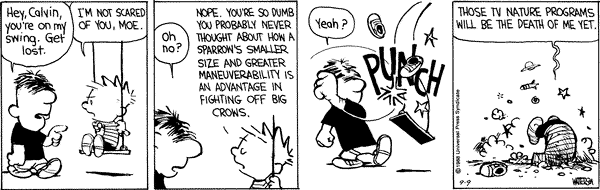
I know from personal experience when things are starting to go well as we are serving the Lord for his kingdom, that is when the Enemy attacks. He knows where we are weak and that is where he strikes. He is like a schoolyard bully. Along those lines I have some comics to share by Bill Waterson. Everyone here is familiar with Calvin and Hobbes, right? Calvin is a six-year-old boy and Hobbes is his stuffed tiger. Calvin is weak and, like the church of Philadelphia, he runs into some problems with bullying.


In much the same way that Moe is bullying Calvin here, the 1st Century Broad Street bullies of Philadelphia are picking on the church in their city. The Christian church in Philadelphia is quite small. It is in a large and prosperous Greek city in the Roman Empire whose citizens’ predominately worship traditional Greco-Roman idols and there is this other bully that is picking on them. This other bully is actually a group of bullies know as, in Verse 9, the ‘Synagogue of Satan’.
.
Now the ‘Synagogue of Satan’ isn’t a street gang like the ‘Indian Posse’. It isn’t a motorcycle club like the ‘Hell’s Angel’s’. ‘Synagogue of Satan’ isn’t even a name that they give to themselves. It is more like an insult or a derogatory epitaph, like when a former US president lumped together three of his presumed adversaries as ‘the axis of evil’ – there never was any such ‘axis’, those countries weren’t even traditional allies; it was just a way of pointing out that the US doesn’t like those countries and to watch out because the Americans are reserving the right to invade and conquer them. It was a way to delineate, as that same president said, who is with us and who is against us. This is the same thing with the ‘Synagogue of Satan’.
.
By ‘Synagogue of Satan’, Verse 9, John means, people “who claim to be Jews though they are not, but are liars.” This we need to know a little bit about. We know that God created the whole world (Genesis 1-2). We know that as early as Genesis 12:3, God promises that the whole world will be blessed (by Jesus) through Abraham. We know that all of history points to Jesus as the Christ. The people of Israel know this as much as anyone but when Jesus actually comes the people of Israel are divided. Some accept Jesus as Lord – these are the people that today we call ‘Christians’.  Most of the New Testament refers to Christians as ‘Saints’ and John in his letter here calls them the ‘true Jews’ or the ‘real Jews’ because they are the ones who embrace the Jewish Messiah. These real Jews, Saints, the Christians are the ones who acknowledge that God has done and is doing what God promised to do all along and they are the ones who choose to experience His joy in the midst of the real tribulations of this world, like those in the church in Philadelphia.
.
When Jesus came, the real Jews, the Saints, the Christians, they set aside a lot of their old traditional cultural ways such as animal sacrifices, and worship at the temple, and various dietary laws because that was what they were doing in order to get ready for Jesus’ arrival; now that he has come they no longer need those things. Like this week, we set up the tables for the Lenten lunches on Thursday; Sylvia organized it. She got together all the plates and cutlery, and Stephen physically cleaned and arranged the tables and chairs in the gym and we put out tablecloths and organized the corps here to accommodate the luncheon. Now when the lunch was over, we didn’t leave the tables set out in our gymnasium with all the plates and cutlery upon them; we didn’t leave the corps like that. We have floor hockey with the youth on Fridays and basketball with the RCMP on Wednesdays among other outreaches so leaving everything set up for a lunch that has already happened is not only pointless but it gets in the way of real, practical, everyday ministry. That is the same with the old Israelite traditions; so, as Jesus has already come it is pointless to follow all of those Old Testament procedures, they are fulfilled now. The lunch is complete; it is time to put that stuff away. This is what the real Jews, the Saints, the Christians, realized.
.
This next part is important. The ‘Synagogue of Satan’, the people who people “who claim to be Jews though they are not, but are liars” – they actually realized this too. Today, nobody follows the traditions of the old Israelite religion. They can’t because Jesus has already come and rose again. The lunch has already been served. You can’t eat it again. It is finish. The ‘Synagogue of Satan’ of the 1st Century and the Jews of today no longer practice the old Israelite traditions either.
.
Today we might call the spiritual descendents of this ‘Synagogue of Satan’, ‘practitioners of the Jewish faith’ –well, I wouldn’t actually recommend that you call someone of the Jewish faith a member of the ‘Synagogue of Satan’ – that might not go over so well. Some of the reasons that John uses this harsh epitaph for them probably relate to how those Jews treated the real Jews, the Saints, the Christians at the time of the writing this letter in the decades after the resurrection of Jesus and the destruction of the Temple in Jerusalem. Remember that they were all Israelites at first:  both the ‘Synagogue of Satan’ Jews and the real Jews who are the Saints and the Christians. After Jesus rose from the grave and the ancient Israelite religion was fulfilled in Christ, the ‘Synagogue of Satan’ rebelled against this and at a meeting in the city of Jamnia they chose their own canon of Scripture and formulated their own new religion, which today we call Judaism. It was based upon, among other things, the so-called Eighteen Benedictions.[5] I am going to read some of what this early document of Judaism says about the real Jews, the Saints, the Christians. This is what it says about Christians:
For apostates let there be no hope, and the kingdom of insolence mayest thou uproot speedily in our days: and let Christians and the heretics perish in a moment, let them be blotted out of the book of life and let them not be written with the righteous.[6]
.
You can see now a little bit about why the Christians might not be so happy with this new group who is openly attacking them in this way. You can understand why in these early days John might refer to these Eighteen Benedictions Jews as the ‘Synagogue of Satan’. And there is more. The ‘Synagogue of Satan’ is persecuting the real Jews who are the Saints and the Christians.[7] They are making life miserable for them – even more miserable than the 20th Century’s ‘Broad Street Bullies’ or Moe, Calvin’s schoolyard bully. The Christians are being persecuted and the Christians are suffering but in Philadelphia of the first century they are holding strong. And so God gives them this encouragement, Verse 8: “I know your deeds. See, I have placed before you an open door that no one can shut. I know that you have little strength, yet you have kept my word and have not denied my name.” And Verse 11, “ I am coming soon. Hold on to what you have, so that no one will take your crown.”
.
Jesus is telling them that no matter how bad life gets, even as the Empire may eventually throw you to the Lions, even as your own countrymen turn their backs on you, even as those whom you love reject you and even if they pray with the ‘Synagogue of Satan’ that your name be blotted out of the book of life, everything will be okay.
.
That is the main message of this whole book of Revelation, by the way: no matter what horrible and difficult things happen in this world, God says as long as you turn to Him it will be okay.
.
The church in Philadelphia persevered and God saved the whole city through them and thanks to the Lord, Philadelphia actually became one of the last great bastions of Christianity to fall before the Ottoman Empire. They persevered and God protected them. God protected them and they persevered. It is the same with us today. As life gets difficult – which it will; as life has hard times – which it will; as our hearts grow heavy with sorrow – which they will; as tears well up in our eyes - as they will; as loved ones pass on - which they will; as the worries of our lives weigh down upon us – which they will; we can still persevere and we can still be encouraged that indeed, like the ancient Christian inhabitants of Philadelphia we can make it.
.
Jesus warns us that difficult times, like those recorded in Revelation are coming.  Luke 21:18-19 records, “But not a hair of your head will perish. Stand firm, and you will win life.” Jesus promises, Hebrews 10:36, that we will receive what he has promised and we can stand strong and we can persevere and Jesus promises that, as Matthew 6 records, if we seek Him we will find Him.
.
So I encourage us today that no matter what problems are facing you, no matter how many questions, fears, or doubts are in our minds, no matter how challenging life gets, as we turn to God, it will all be okay. Jesus promises, Verse 8: “I know your deeds. See, I have placed before you an open door that no one can shut. I know that you have little strength, yet you have kept my word and have not denied my name.” and Verse 11, “ I am coming soon. Hold on to what you have, so that no one will take your crown.”
.
Let us pray.
.
---

[1] Leon Morris, Revelation: An Introduction and Commentary. Downers Grove, IL : InterVarsity Press, 1987 (Tyndale New Testament Commentaries 20), S. 80
[2] William M. Ramsay, The Letters to the Seven Churches of Asia (London: Hodder & Stoughton,:1904), 398.
[3] Simon J. Kistemaker, Exposition of the Book of Revelation (New Testament Commentary: Grand Rapids, Michigan: Baker Academic, 2007), 156.
[4] cf. Captain Michael Ramsay, Revelation 3:20: Hello, is anybody in there? Presented to Swift Current Corps of The Salvation Army (30 August 2009). Available on-line: http://sheepspeaks.blogspot.ca/2009/08/revelation-320-hello-is-anybody-in.html?m=1
[5] Simon J. Kistemaker, Exposition of the Book of Revelation (New Testament Commentary: Grand Rapids, Michigan: Baker Academic, 2007), 156.
[6] William Horbury, ‘The Benediction of the Minim and early Jewish-Christian Controversy,’ JTS, n.s. 33.1 (1982): 20.
[7] Cf. Craig K. Koester, ‘Revelation’s Visionary Challenge to Ordinary Empire,’ Interpretation: A Journal of Bible and Theology, ‘Revelation as a Critique of Empire, Vol. 63 no 1, (January 2009): 7.